Welcome back to the Ceramic Materials Workshop blog.
Today we are talking about boron, one of the most important and most misunderstood parts of mid-fire glaze chemistry.
Boron matters because it helps us make glazes work at lower temperatures. If you are moving from cone 10 to cone 6, or building a cone 6 glaze from scratch, boron is often one of the major tools we use to get the glaze to melt properly.
But boron is not magic. And it is not something we should understand only by material name.
We need to understand it chemically.
What is Boron?
Boron is an element that we use in glazes most often through boron-bearing materials like frits, Gerstley Borate, Colemanite, or other borate sources.
In glaze chemistry, we usually talk about boron as boron oxide, B₂O₃.
The important thing to understand is that boron is a glass former. It helps make glass. That matters because glazes are glass: thin coatings of glass melted onto the surface of clay.
CMW teaches glaze chemistry from that starting point: glazes are not mysterious surfaces; they are chemical systems made from glass formers, fluxes, stabilizers, and colorants.
Why is Boron Used in Glazes?
Boron is used because it changes the temperature at which a glaze can become a functional glass.
That sentence matters.
People often say boron is a flux. In the CMW framework, that is not the best way to understand it. Boron is a glass former that allows the glaze to work at a lower temperature.
It does not replace the rest of glaze chemistry.
It does not excuse poor flux balance.
It does not make a weak glaze strong just because it melted.
At cone 10, many glaze systems can melt with silica, alumina, alkali fluxes, and alkaline-earth fluxes. At cone 6, that same chemistry usually needs help. Boron gives us a way to lower the working temperature while still building a glass.
But that help has limits.
Too little boron and the glaze may remain underfired. Too much boron and the glaze may become overfired. That can show up as running, color loss, excessive movement, surface change, or durability problems.
None of those outcomes belong to boron alone. They belong to the whole glaze.
How Much Boron Do We Need?
This is where we have to avoid the easy answer.
There is not one correct boron number for every cone 6 glaze.
In CMW testing, a boron level around 0.15 UMF is often a useful reference point for many cone 6 glazes. But that is not a rule. It is not a recipe. It is not a guarantee.
It is a place to begin thinking.
The correct boron level depends on the rest of the chemistry: silica, alumina, alkali fluxes, alkaline-earth fluxes, colorants, opacifiers, and any other temperature-lowering effects already present in the glaze.
That is why the question cannot be, “How much Gerstley Borate do I add?”
The better question is, “What does this glaze need chemically to mature at this heatwork?”
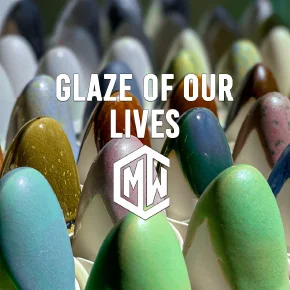
In the test image shown here, the boron level increases in small UMF steps. Those changes may look small on paper, but they are not small in the fired result. The glaze moves through a range of melt behavior, color development, and eventually overfiring.
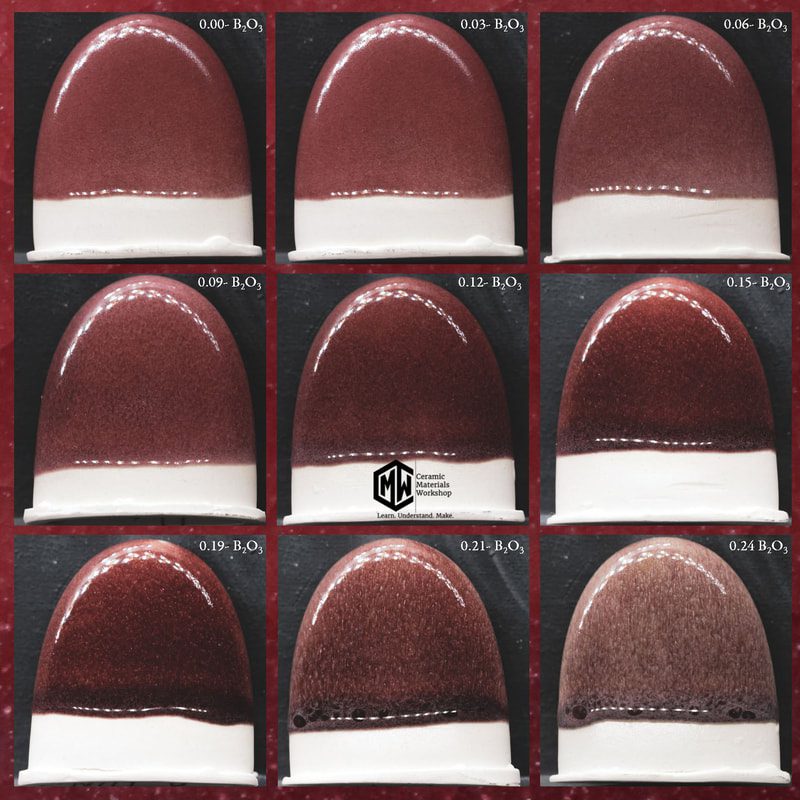
In this specific test, the color strengthens as the boron reaches a useful range, then fades and turns brown as the glaze is pushed too far.
That does not mean boron always improves color until a single magic number, then ruins it. It means this glaze had a working range, and the test found the edge of that range.
That is the point.
Boron and Color
Boron can affect color, but not in a universal way.
It is too simple to say boron makes colors brighter. Sometimes it does. Sometimes it does not. Sometimes the color improves because the glaze is finally melting well enough. Sometimes the color weakens because the glaze is overfired. Sometimes the color shifts because the viscosity, surface, phase behavior, or overall chemistry has changed.
Color does not come from one ingredient alone.
Color comes from the interaction between the colorant and the whole glaze chemistry. The same colorant can behave differently in different glazes because the glaze around it is different.
So when a boron test changes color, we should not say, “Boron did that,” and stop thinking.
Boron changed the glaze chemistry. The changed glaze chemistry changed the color response.
That is the more useful answer.
Boron and Durability
Boron can be part of a durable cone 6 glaze.
That does not mean every boron glaze is durable.
Cone 6 is not automatically weaker than cone 10. A well-designed cone 6 glaze can be excellent. But the glaze still has to be chemically sound. It still needs enough glass former. It still needs appropriate alumina. It still needs a sensible flux balance. It still needs to fit the clay body. It still needs to be tested.
Melting is not the same as durability.
That is one of the big traps with boron. Because boron can make a glaze melt, it can make a glaze look successful before the chemistry is actually good. A melted surface is not proof that the glaze is durable, stable, or appropriate for functional work.
Boron helps us get the temperature right. It does not remove the need for the rest of glaze chemistry.
Material Names Are Not Chemistry
Another important point: boron sources are not interchangeable by name alone.
A frit is not just “boron.” Gerstley Borate is not just “boron.” Colemanite is not just “boron.”
Each material brings a package of chemistry with it. Some bring sodium. Some bring calcium. Some bring both. Some bring other complications. Some are more consistent. Some are less consistent.
Changing the boron source can change the boron level, the flux ratio, the silica, the alumina, the melt, the application behavior, and the fired result.
That is why material substitution has to be chemical substitution, not name substitution.
Temperature Effects Stack
Boron is not the only thing that lowers the working temperature of a glaze.
Flux balance matters. Silica and alumina levels matter. Some glaze structures are already naturally lower-temperature. Some colorants and opacifiers affect melt behavior. Some recipes are already close to being overfired before boron is adjusted.
Those effects stack.
So a glaze with boron plus low silica and alumina plus a very active flux balance may not simply be a “cone 6 glaze with boron.” It may be a lower-temperature glaze being fired too hot.
That distinction matters because the kiln did not cause the problem by itself. The chemistry invited the problem.
In Conclusion
Boron is one of the main reasons mid-fire glazes can work as well as they do.
But boron does not give us an easy answer.
Boron is a glass former that helps control temperature. The right amount depends on the whole glaze. Too little can leave the glaze underfired. Too much can push the glaze past its useful range. The correct level is not found by memorizing a number or trusting a material name.
It is found by calculation, testing, and reading the fired result through the chemistry.
The CMW approach is not:
“How much boron should I add?”
The CMW approach is:
“What does this glaze need, chemically, to become the glass I want at this heatwork?”
That is how we get boron levels right.
To learn more I urge you to take one of our courses but I know, you’re probably on the fence right? Do not worry! Try out CMW’s FREE sample class below!
Ready to dive deeper?
Loved learning about ceramic glazes? Want to go even deeper? Check out our Workshops & Courses, now available in Spanish, or YouTube Channel where Matt breaks it all down, myth-busting and Stull chart included!