One of the most useful measurements in ceramics is absorption.
Unfortunately, it is also one of the most misunderstood.
Most potters encounter absorption as a number on a clay manufacturer’s data sheet. Some people use it as a pass-fail test for functionality. Others ignore it completely.
Neither approach is particularly useful.
Absorption is not really a conversation about water. It is a conversation about vitrification.
What Is Absorption?
Absorption measures how much water a fired clay body can take in.
That sounds simple enough, but what we are really measuring is the amount of open porosity remaining in the body after firing.
A highly porous body absorbs more water.
A less porous body absorbs less.
The number itself is not the important part. The important part is what the number tells us about the state of the fired clay body.
Want to test your commercial clay body profile testing FOR FREE? (Click here!)
Absorption and Vitrification
As a clay body is fired, it goes through a process we call vitrification.
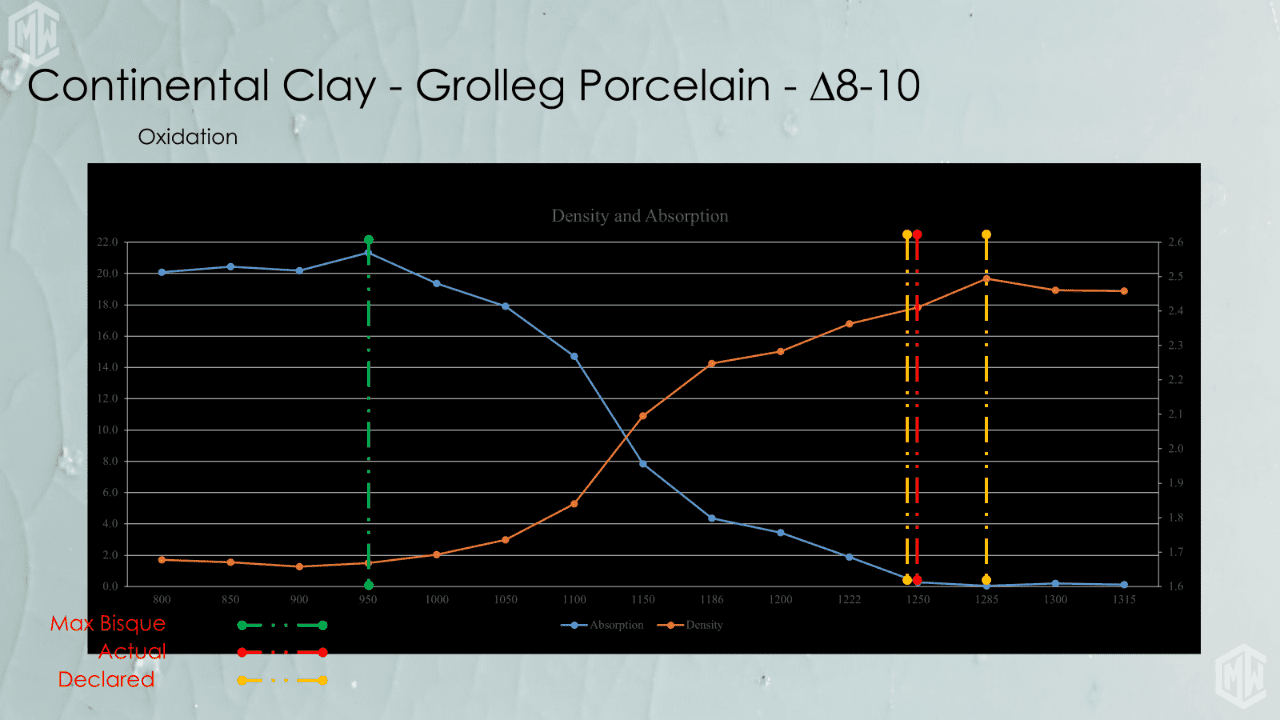
During vitrification, the body becomes progressively denser. The amount of open porosity decreases and absorption falls. If you graph absorption against temperature, you typically see a plateau at lower temperatures followed by a steady drop as vitrification begins. Eventually the body reaches its maximum maturity and absorption bottoms out.
This is why absorption is such a valuable measurement.
It allows us to observe the vitrification process directly.
The body may look identical from one firing to another, but absorption can reveal that the underlying structure has changed significantly.
Every Clay Body Is Different
One of the common mistakes potters make is assuming that clay bodies behave similarly.
They do not.
Different clay bodies have different absorption rates at the same temperature. Even bodies that look similar can behave very differently. A porcelain from one manufacturer may have a completely different absorption curve than a porcelain from another.
This is why knowing the absorption of your specific clay body matters more than knowing the absorption of “porcelain” or “stoneware” in general.
The clay body does not care what category we put it in.
It only responds to its chemistry and firing history.
Why Potters Should Care
Absorption affects far more than most people realize.
Most discussions focus on the final fired clay body, but absorption becomes important long before the glaze firing.
One of the most direct effects is glaze application.
When we dip a piece into a glaze, the clay body absorbs water from the glaze suspension. As the water moves into the clay body, glaze particles are left behind on the surface. The amount of water the clay body absorbs directly influences how much glaze is deposited.
This means absorption is not just a clay body property.
It is an application variable.
A clay body with higher absorption will generally build glaze thickness faster than a clay body with lower absorption. Two pieces can be dipped into the same bucket for the same amount of time and still receive very different glaze thicknesses because their absorption rates are different.
This is one of the reasons potters often believe a glaze “likes” one clay body and “dislikes” another.
In many cases, the glaze chemistry has not changed at all.
The thickness has.
Small Changes Matter
One of the surprising lessons from absorption testing is how sensitive glaze application can be to relatively small changes.
A few percentage points of absorption can dramatically change how much glaze is deposited on the surface. In Ceramic Materials Workshop course, Making Glazes Make Sense, we demonstrate this with multiple clay bodies and multiple bisque temperatures. Changes that seem minor numerically can create substantial differences in application thickness and ultimately in fired appearance.
This is where many glaze problems begin.
The glaze recipe has not changed.
The firing has not changed.
The clay body may not have changed.
But the absorption rate has changed, and that changes the amount of glaze being applied.
Because glazes are highly dependent on thickness, the resulting surface can look completely different.
The Bisque Temperature Question
Absorption also helps explain one of the most debated topics in ceramics: bisque temperature.
Many potters assume that a hotter bisque is automatically better. The data suggest the situation is more complicated.
When we examine absorption curves, most clay bodies show a relatively stable absorption plateau at lower temperatures. Eventually the body enters the vitrification slope and absorption begins decreasing rapidly.
The important detail is consistency.
If a bisque temperature sits on the vitrification slope, even small variations in firing can produce significant changes in absorption. A kiln that fires slightly hotter or slightly cooler can generate noticeably different absorption rates from load to load.
The result is inconsistent glaze application.
The glaze did not change.
The bucket did not change.
The potter did not change.
The absorption changed.
This is one of the reasons we often prefer bisque temperatures that remain on the absorption plateau rather than on the active vitrification slope. The goal is not to maximize absorption. The goal is to maximize consistency.
The Functional Conversation
Absorption often enters the conversation when discussing functional ware.
At Ceramic Materials Workshop, we use 0.5% absorption as the benchmark for a vitrified functional clay body. When absorption remains significantly above that level, it indicates that substantial open porosity is still present within the fired body.
The important point, however, is not the number itself.
The value is useful because it describes the condition of the clay body. It gives us a measurable way to discuss vitrification rather than relying on assumptions or appearance alone.
A clay body may look mature.
A glaze may look beautiful.
The piece may appear successful.
Absorption gives us another way to evaluate what is happening beneath the surface.
What Absorption Cannot Tell You
As useful as absorption is, it is still only one measurement.
It does not tell us everything about a clay body.
Two bodies can have similar absorption values and very different chemistries. Two bodies can reach similar absorption levels through very different vitrification pathways. Density, thermal expansion, fired strength, color response, and firing range all remain important considerations.
Absorption is powerful because it provides a measurable window into what is happening inside the body.
It is not powerful because it replaces all the other measurements.
Why We Test
The value of absorption testing is not that it gives us an answer.
The value is that it gives us information.
A clay body may look mature.
A glaze may look beautiful.
A firing may appear successful.
Absorption allows us to move beyond appearance and evaluate what the clay body is actually doing.
That is why absorption remains one of the most useful measurements in ceramics.
Not because it tells us whether a clay body is good or bad.
Because it helps us understand how the body responds to heatwork, how it progresses through vitrification, and how consistently it will perform in the studio.
In Conclusion
Absorption is one of the simplest measurements we can make in ceramics, but it tells us a remarkable amount about a clay body.
It provides a direct window into vitrification, helping us understand how a body changes as it moves through the firing process. It helps explain differences in glaze application, reveals the effects of firing temperature, and gives us a practical way to compare clay bodies and firing schedules.
Most importantly, absorption gives us data.
And in ceramics, good decisions are almost always easier to make when we understand what the materials are actually doing.
Rather than treating absorption as a pass-fail test, it is more useful to view it as a tool for understanding the fired clay body.
The more we understand the body, the better we can understand the results we see coming out of the kiln.
Still Curious? Watch our YouTube!
Self-Absorbed | How to find your clay body’s absorption – Watch as Rose guides you through the entire process, from preparing your clay samples to calculating the absorption rate. You’ll learn how to ensure that your clay is properly vitrified, making it durable, non-absorbent, and ready for functional use.